
We are developing new clinical practice guidelines for the early diagnosis and management of colorectal cancer, also known as bowel cancer, in people under 50. These guidelines will help health professionals know how to best care for younger people before and after their diagnosis.

Prioritisation survey results

We recently invited people with lived experience of early-onset colorectal cancer (EOCRC), health care professionals, researchers and policy makers to complete an online prioritisation survey.

The survey aimed to identify the highest priority topics that we should address in the new guidelines to best support clinicians providing care to people with early-onset colorectal cancer.
Up next…

A Baseline Evaluation survey is now open until 9 August. We’re asking Australian health professionals how they currently make clinical decisions in their care of patients with early-onset colorectal cancer.

Logo with a round circle and the words clinical practice guidelines early diagnosis and management of early onset colorectal cancer

Guideline development process

These guidelines will bring together peak health professional and consumer advocacy bodies from across Australia whose members are providing clinical care to those with early-onset colorectal cancer.

ALEC’s team of experts will review the latest research from around the world with a focus on priority topics including signs and symptoms for early diagnosis, the multidisciplinary care team, mental health support, financial and employment supports, treatment planning and treatment.

Panels of health professionals, researchers, and people with lived experience will meet regularly with ALEC’s Evidence Review Team to draft recommendations based on the research evidence.

Draft recommendations are small pieces of advice, usually one or two sentences, that will later become the guideline.

A representative from each of the Member Organisations will be asked to endorse the draft recommendations at a Steering Committee meeting before we take the drafts to the public for feedback.

Find out more about our panels and Steering Committee

The draft recommendations are then shared with the public. This gives the community a chance to provide feedback over a 30 day period and helps make sure the advice is clear, useful and appropriate.

Once public consultation is complete and feedback incorporated where appropriate, the draft recommendations are sent to the National Health and Medical Research Council (NHMRC) for approval.

The clinical practice guideline can then be used by clinicians for up-to-date advice on how to care for young people under 50 with colorectal (bowel) cancer. The recommendations will maintain their draft status until approved by the National Health and Medical Research Council.

Guideline development committee, groups and panels
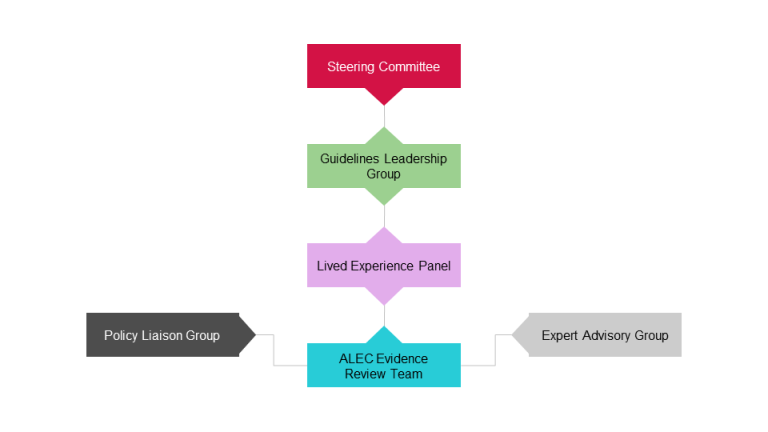
The guidelines are overseen by a national Steering Committee (SteerCo) which is composed of a representative from each of the member organisations. Members are nominated to the SteerCo by their respective organisations.

Our Steering Committee:

  • Alison Khor, Advanced Pharmacy Australia
  • Stephane Bouchoucha, ACIPC
  • Lesley Andrew, APNA
  • Jo Abbott, APS
  • Julien Wiggins (Proxy: Claire Annear), Bowel Cancer Australia
  • Alana Fitzgibbon, CNSA
  • Connie Diakos, COSA
  • Cherry Koh, CSSANZ
  • Tim Price, MOGA
  • Chelsea Menchin, Palliative Care Australia
  • Helen Mohan, RACS

    As well as representatives for:
  • CRANAplus
  • Australian Indigenous Doctors’ Association
  • Australasian Society of Genetic Counsellors
  • Australasian Association of Nuclear Medicine Specialists

The GLG will work with the Evidence Review Team to develop PICO criteria for prioritised clinical questions, review and revise draft recommendations and provide advice to the Steering Committee on any emerging clinical research or strategic issues that may impact the work of the guideline.

Our Guidelines Leadership Group are:

  • Amanda Richardson
  • Ayesha Saqib
  • Catherine Trevaskis
  • Christine Minty-Walker
  • Jaymee Goldsmith
  • Jim Siderov
  • John Nik Ding
  • Katherine Goodall
  • Meghana Maddula
  • Mudy De Silva
  • Nina Di Santo
  • Paula Chen
  • Penelope De Lacavalerie
  • Prasad Cooray
  • Ria Joseph
  • Sian Greening
  • Susan Shedda

The Lived Experience Panel consists of up to 20 people with lived experience of early-onset bowel cancer, who advise the GLG and Evidence Review Team. Lived experience panel members will provide strategic advice and draw on their lived experience of early-onset colorectal cancer at all stages of Guidelines planning, development and dissemination.

The Evidence Review Team is comprised of individuals experienced in clinical practice guideline development, using GRADE methodology and producing guidelines in accordance with NHMRC requirements.

The development of these guidelines is also supported by:

  • ALEC Academic Director 
  • ALEC Clinical Director
  • ALEC Guidelines Program Manager
  • ALEC Director of Evidence and Methods
  • ALEC Research Fellows
  • ALEC Evidence Team 
  • EOCRC Guidelines Project staff
  • Independent Conflicts of Interest Committee

The Policy Advisory Group will include invited representatives from Commonwealth and jurisdictions, peak bodies, and healthcare advocacy from across the country, including those who can provide advice on policy issues relating to Aboriginal and Torres Strait Islander healthcare, and rural and remote healthcare. They are not a decision-making group but provide advice on Guidelines topics including policy and legislative impacts on implementation and dissemination.

The Expert Advisory Group will provide topic-specific expertise that can be called on as required to support the work of the EOCRC Guidelines group. They are not a decision-making group but provide advice on specific topics before recommendations and associated content proceed through the Guidelines panels. Their perspectives are presented to the panels via the Evidence Team members.

Key dates

Bowel Cancer Australia
Australian Living Evidence Collaboration